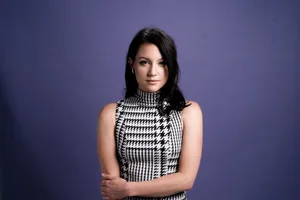
Robert Peng once made a video about Vancouver housing that got a million views, and for a little while he believed his life had changed. "Holy shit, a million views," he remembers thinking. "This is it. This is where I make it." It was not where he made it. It was, he says, "one more step on the resume."
In about 10 years of stand-up, the Chinese-born Vancouver comic has collected most of the moments that are supposed to turn a career: the viral clip, a commercial, a scene with Russell Peters on the Crave series The Office Movers, and a festival set where Theo Von, who didn't know his name, brought him out as "the Asian guy." None of them was the big break. There isn't one, he says. There are steps, most of them don't pay, and the comics who quit are usually the ones who were waiting for the leap.
His next step is a steakhouse on a mountain. On Saturday, November 21, Peng headlines Comedy Night at Longshots, presented by Laugh Lab, at Longshots Steakhouse in Apex Mountain Resort's village, about 30 minutes up the road from Penticton. The lifts aren't projected to open until December 12, so this is a night at Apex for people who don't ski.
Reza Houshmand and Nicolle Hodges spoke to him before this show. Full interview above. Written interview edited for clarity and brevity.
Reza: Do you remember your first set?
I barely remember my first set. It was something weird. But it was at Yuk Yuk's. They used to have a pro-am show where the newer comics are encouraged to go up, and it was a lottery. So I got on the lottery once, and I went from there.
Nicolle: Painters and writers can practise alone. Comics have to fall on their faces in public?
Yeah. Which makes it crazy that a lot of newer comics are like, "This is my first set. Let's bring all my friends." I'm like, "But you're gonna just embarrass yourself." But that is actually very encouraged. Open mics will be always terrible if newer people don't bring their friends and family. It's like a paradox. Open mics are the hardest audience, but that's where you start.
Is that why you hid comedy from your parents?
I was lucky because my parents weren't in Canada for three to four years, so it was pretty easy to hide it from them because I was living alone. And then when they came back, they were like, "What are you doing?" And I said, "I'm just going out and stuff." And then I told them after I had that YouTube video out that went pretty successful. That's when they knew.
So you waited for proof.
Asian parents, they don't care what you do as long as you can support yourself. If they can see the money, they will support it. It's not about bringing honour to the family. It's literally about financial support. And if you can find a wife and afford a house, it's all good. They're like, "Oh, why don't you stay in your engineering job?" "My comedy job..." It does not, but: "My comedy job brings more money." And it's, "Oh, okay."
Reza: What surprised you about performing in small towns?
Honestly, people say Alberta is more racist. It's not. They're all the same. You can't have the assumption that a small town, they're gonna be dumb. That's the wrong assumption to have, and then you're gonna have this attitude where it's like, "Oh, I'm so high and mighty. I am from the big cities." People understand different things in a small town, so you gotta take advantage of that. But you really shouldn't treat it differently. That's my takeaway.
Nicolle: Do you chase topical material?
The longer-lasting jokes are not topical. If it's a topical joke, you can keep it for a month or so. The internet makes the timeline go so fast. I could joke about Trump two months ago, and then you don't even remember what he does anymore, because so many crazy things happen. Also, I'm from China, so I don't do political jokes in general. There's touchy subjects you can't really talk about.
Reza: Is there a formula to writing jokes?
I don't really write that much. I just riff on stage. And I guess my formula is if something happens, you hate on it. You're at a wedding. This is a very beautiful thing. What's the worst about it? And then you go off that. I do appreciate everything. Just take the thing that's bothering you and yell about it on stage until you find it funny.
Nicolle: Can you turn off your comedy brain?
I feel like I'm turning the me on off stage. People will say, "You behave really differently off stage than on stage." It's like, I'm more comfortable on stage, so I behave more normal. Off stage I'll try to behave more. I think it's 'cause I got bullied when I was young. Or just, "Oh, why do you keep talking? Why are you so annoying?"
Reza: What was it like sharing a show with Theo Von?
It was at the Great Outdoor Comedy Festival, shout out to them, very fun show. Von barely knew my name. He was like, "Bring the Asian guy out." I was like, "Okay." That was quite awkward, but it was fun. I met Russell Peters once, and also Tony Hinchcliffe once, and they barely knew my name. I don't stand out in a crowd.
You grew up watching Russell Peters?
He inspired me to do comedy. He's a great guy, really kind. I was doing a TV show called Office Movers, and I saw the script and it said Russell Peters. Holy shit. So I did a scene with Russell Peters. But when it comes to talking, I'll just leave him alone. Famous comics, they don't wanna be bothered. But I feel like I leave them alone too much. I leave them alone so much that they don't remember me.
Nicolle: Was there a yes that changed everything?
The funny thing is that it's not a pivotal moment. I thought there were a few moments where it was a big break, but it turned out to be just one more step. My comedy video about Vancouver housing went viral, and I was like, "Holy shit, a million views. This is it." It was one more step on the resume. Then, "Oh, I got a commercial gig. This is it. I'm gonna make it from this commercial." It's just one step in a process. A lot of people say, "I had this one big break." But if you look at their resume, they had the foundation built up, and this one thing is just the most visible thing.
So what stops you from quitting?
That mentality actually helps. A lot of comics have this expectation: "I got my big break. This is where I flip." But if it's a gradual process, you can work towards it. You have more manageable goals. One step at a time. My theory of why comedians quit is either they get it too easily or they never got any of the steps. Some got everything so easily, they made the giant leap and say, "I made the leap. Now what?" Others never adjust. They're stuck at open mics. They don't plan the next step.
Would you tell someone with kids to do this?
If you have a family and a full-time job and you're pretty stable, sure, do comedy. But pursue comedy over your kids? That could be rough. I'm out three days a week doing comedy. It's like having a second job that doesn't pay as well as Uber. Most of these tours at the start don't make money. You're probably losing money, and you're like, "Holy shit, I travelled all the way to freaking Halifax, red-eye flight." And you're sleeping in a dingy hostel with five other dudes who are on meth, and you finally show up to the show and you didn't sell any tickets. It happens.
This sounds like you're thinning out the competition.
No, no, no. Being on the road is hard. It's fun, but it's also hard.
Reza: Have you ever done a set in Mandarin?
I really need to get into that. My Mandarin's not good, so it's gonna be a lot of Chinglish, obviously. The weird thing is Chinese people don't laugh as hard, so maybe they're just having a good time. I've seen so many situations where an old white guy is sitting in the front with arms crossed the entire time. He's like, "Mm." And then after the show he's like, "Great job, bud. I'll buy your merch. I loved you so much." And I'm like, "I thought you hated me this entire time." So unless it's a really hard bomb, always talk to your audience afterward. Get their Instagram. You're gonna come back to the town anyway.
Nicolle: Is there a stage where you'd feel you'd made it?
I used to. But once you realize it's a gradual step, you're looking for the next goal, next goal, next goal, and you just keep climbing. It is what it is.
Reza: What should people expect on Saturday?
You're gonna expect crazy things. I'm a crowd-working comic. I yell at people a lot, I make fun of people a lot. But don't be afraid to sit in the front. I don't go too hard on everybody. It's gonna be unhinged, I think.
It isn't snowing here, for the record.
Oh, okay. Good. Then I'll definitely be there. I'm never really committed to driving through a blizzard. But if it is a blizzard, definitely come out, because if it's a sold-out show, I will risk the blizzard. I have winter tires on, by the way. It'll be funny if you get an Asian guy who has never driven through the mountains to drive through the mountains because it's a sold-out show, so I have to be there. So please sell out the show. And if it's a blizzard, it'll be funny.
Comedy Night at Longshots with Robert Peng is Saturday, November 21, at 8 p.m., at Longshots Steakhouse on Strayhorse Road, at the entrance to Apex Mountain Resort's village, about 30 minutes from Penticton. Entry is by applying on Portal. Longshots usually serves dinner Fridays and Saturdays from 5 to 8:30 p.m., with mains from $31 to $50, so book ahead if you want to eat before the show. Bring winter tires.